
How 3D Animation Software Has Evolved in India: From Maya and Mudbox to Blender
How 3D Animation Software Has Evolved in India: From Maya and Mudbox to Blender
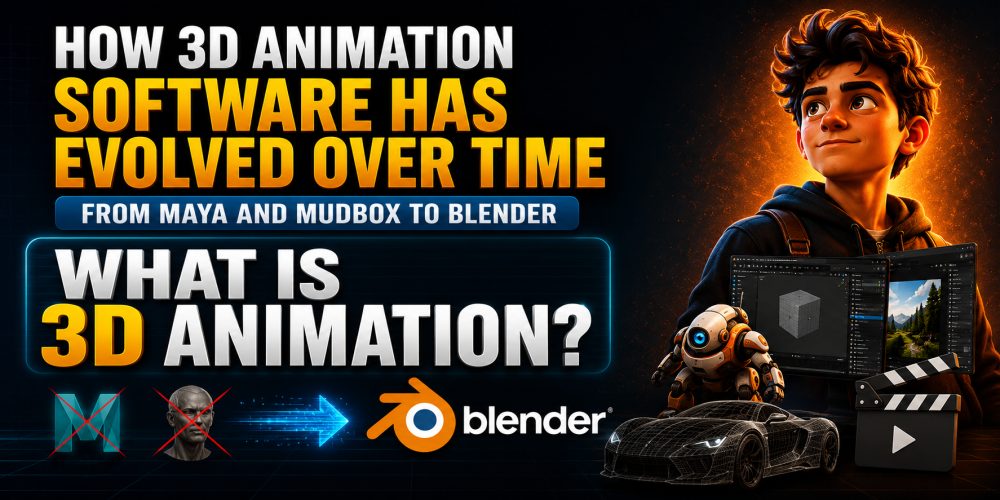
India’s 3D animation industry started with expensive licensed software like Autodesk Maya, Mudbox, and 3ds Max in the early 2000s–2010s. Over the last decade, Blender — a free, open-source alternative has become the preferred tool for freelancers, startups, and small studios, while Maya remains the standard for large VFX studios and feature film production. Neither tool has replaced the other; they now serve different segments of the same industry.
What Is 3D Animation?
3D animation is the process of creating moving digital objects and characters in a three-dimensional environment. Unlike 2D animation, which exists only in height and width, 3D animation adds depth making characters, products, and environments look realistic. It is used across films, television, advertising, architecture, gaming, medical visualization, product design, education, and industrial training.
What Is 3D Animation Software?
3D animation software is a computer program that lets artists model, sculpt, texture, rig, animate, simulate, render, and edit three-dimensional objects. These tools turn an idea into a visually engaging animation usable for entertainment, marketing, engineering, or business communication.
India is now one of the world’s fastest-growing animation markets spanning Bollywood VFX, gaming studios, advertising agencies, and manufacturing companies. The software powering that growth has changed dramatically over the last two decades.
The Early Days: Maya, Mudbox, and 3ds Max (Early 2000s–2010s)
- Autodesk Maya became the industry standard. Most Indian animation institutes trained students on Maya for character animation, rigging, lighting, rendering, and VFX — it became the backbone of production pipelines for films, TV, commercials, and gaming.
- Mudbox specialized in digital sculpting, often paired with Maya for detailed characters, creatures, and environments.
- Autodesk 3ds Max was widely used for architectural visualization and product modeling.
- Cinema 4D gained traction among motion graphics artists for its user-friendly interface and broadcast graphics integration.
Why the Industry Started Looking for Alternatives
- Cost annual subscriptions made multiple licenses unaffordable for freelancers, startups, and small production houses.
- Hardware requirements many packages demanded high-end workstations with expensive GPUs and large memory, which smaller teams struggled to maintain.
- Learning curve Maya’s extensive feature set, while powerful, overwhelmed beginners.
The Rise of Blender
Blender was initially seen as a tool for hobbyists and students, not professional studios. That changed over the last decade.
Continuous development by a global open-source community turned Blender into a complete 3D creation suite modeling, sculpting, animation, rigging, UV mapping, texturing, compositing, simulation, motion tracking, video editing, and rendering, all in one application.
Blender’s biggest advantage: it’s completely free. This removed the entry barrier for aspiring Indian animators students could learn without licensing costs, freelancers could start with minimal investment, and startups could build creative teams without recurring software expenses. As India’s creator economy grew, Blender became a preferred tool for independent artists and small studios.
Why Blender Gained Popularity in India
Factor | Why It Matters |
Free and open source | Legal for commercial use with no subscription fees |
Continuous updates | Regular improvements to speed and quality |
Integrated workflow | Modeling, animation, rendering, and editing in one app — no switching software |
Large learning community | Thousands of tutorials, courses, and forums for all skill levels |
Modern render engines | Cycles for realistic renders; Eevee for fast real-time previews |
For Indian freelancers and agencies working under tight deadlines, this combination of cost and speed has been especially valuable.
Maya vs. Blender: Is Maya Obsolete?
| Factor | Autodesk Maya | Blender |
| Cost | Paid subscription | Free, open source |
| Best for | Large studios, complex rigging, enterprise pipelines, feature films | Freelancers, startups, small studios, product/architectural visualization, content creators |
| Learning curve | Steeper | More accessible |
| Production pipeline fit | Established in large-scale, collaborative pipelines | Increasingly adopted, but pipeline switching costs remain a factor for large studios |
Is Blender the Perfect Software?
There’s no universally “best” 3D software — the right choice depends on the project:
- Large film productions often still prefer Maya for pipeline compatibility.
- Motion graphics professionals may choose Cinema 4D.
- Digital sculptors may continue using ZBrush for highly detailed character work.
Software is a tool. Creativity, technical knowledge, storytelling, lighting, composition, and animation principles ultimately determine the quality of the final output.
The Future of 3D Animation Software in India
Growing demand from OTT platforms, gaming, architecture, manufacturing, healthcare, education, and digital marketing is creating new opportunities for India’s animation industry. Software is becoming smarter, faster, and more AI-assisted — asset generation, motion capture clean-up, texture creation, and rendering are all becoming more efficient, freeing artists to focus more on creativity and storytelling. Studios today aren’t limited by software availability; they’re empowered by choice.
Frequently Asked Questions
Yes. Blender is a complete, professional-grade 3D creation suite offering modeling, sculpting, animation, rigging, texturing, and rendering. It's widely used by freelancers, startups, and small-to-mid studios in India for product animation, architectural visualization, and content creation.
Yes, especially for anyone targeting large VFX studios or feature film production. Maya remains the standard for complex rigging, large-scale pipelines, and enterprise collaboration.
Cost and target use case. Maya is a paid, subscription-based tool suited to large studio pipelines; Blender is free and open source, favored by freelancers, startups, and smaller studios for its accessibility and integrated workflow.
It depends on career goals. Blender is a lower-cost, accessible starting point for learning core 3D animation principles. Those targeting large VFX studios or film production houses may benefit from also learning Maya, since it remains the industry standard there.
Yes. Cycles produces realistic, high-quality renders suited to final output, while Eevee offers real-time rendering for faster previews — useful for tight-deadline freelance and agency work.
Bringing Ideas to Life with Creative Splash
Search
Categories
- Ad Agency (9)
- Advertising Trends (1)
- Animation (34)
- B2B Marketing (1)
- Brand Video (1)
- Construction Industry (1)
- creative splash (19)
- Explainer video (2)
- Industrial Animation (1)
- Khalbatta (1)
- Motion Graphics (3)
- Photography (5)
- product films (1)
- Short Film (2)
- Social Media Marketing (4)
- TV Commercial (6)
- Uncategorized (2)
- VFX Animation (2)
- Video (26)
- Video Marketing (1)
- Video Marketing Trends (1)
- Video Production (1)
Get A Free Quote
Recent Posts
- What Is a Green Screen and How Does Chroma Key Work?
- More Than a Backdrop: How Motion Graphics and LED Screens Bring Live Events to Life
- How 3D Animation Software Has Evolved in India: From Maya and Mudbox to Blender
- Real vs AI Reels: Which One Stops the Scroll Faster?
- Moment Marketing Explained: How Brands Use Viral Trends to Grow Online
