
More Than a Backdrop: How Motion Graphics and LED Screens Bring Live Events to Life
More Than a Backdrop: How Motion Graphics and LED Screens Bring Live Events to Life
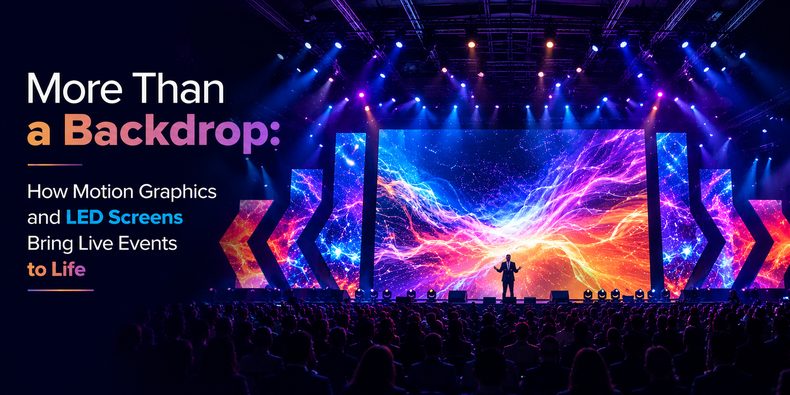
Imagine walking into a large event.
The stage is ready. The lights are dim. Hundreds of people are waiting for the show to begin.
Then the screen behind the stage comes alive.
A logo slowly forms through particles. Colours move with the music. A cityscape transforms into a futuristic environment. A product appears in 3D. As the speaker walks onto the stage, the background shifts with the brand’s visual identity.
Suddenly, the screen is no longer just a screen. It has become part of the experience.
This is where motion graphics for live events and the LED screens that display them make the real difference.
Today, event organisers use animated videos, motion graphics, 3D visuals and LED wall content to create more engaging environments for conferences, concerts, product launches, exhibitions, award ceremonies, festivals and corporate events. Live event video is no longer limited to presentations or camera feeds it’s a visual design element that supports branding, storytelling and audience engagement.
So how exactly do animated backgrounds and LED screens transform a live event? Let’s break it down.
What Are Motion Graphics for Live Events?
Motion graphics are animated visual elements graphic design, typography, illustrations, shapes, 3D elements, video and visual effects combined to communicate an idea or build an atmosphere.
When designed for a live event, they’re displayed on:
LED walls
Large stage screens
Projection screens
Digital backdrops
Exhibition displays
Concert screens
Stadium and arena displays
Instead of one static image running all night, organisers use a series of animated visuals that change with the event’s mood, schedule or performance. A corporate conference might use one animation for the opening, another for speaker intros, animated charts during presentations and branded loops during breaks. A concert might use different visuals for every song.
1. Turning a Simple Stage into a Visual Experience
A physical stage has limits you can change lights, props and set design, but rebuilding the environment between every segment isn’t practical.
An LED wall for events changes that. A single large screen becomes a city, a forest, a futuristic world or a product showroom simply by changing the content on it including full 3D animation and VFX sequences that would be impossible to build physically. See how Creative Splash approaches VFX and 3D work for event and brand visuals.
One stage. Multiple worlds. That’s real creative freedom for event designers and it’s a major reason event LED screen rental has become standard in modern event production.
2. Motion Helps Capture Attention)
A static image communicates information. Movement directs attention.
Compare a static event logo to one that slowly appears through light, particles or 3D animation the second version builds anticipation. Motion can guide the audience toward a speaker, a product, a key transition, or a performance moment.
But this doesn’t mean everything on screen should constantly move. Good event motion graphics rely on controlled movement too much animation becomes distracting. The goal is to support the moment on stage, not compete with it. That balance separates professional event animation from random video loops.
3. Strengthening Brand Identity through Corporate Films and Visuals
Corporate events run for hour’s presentations, speeches, networking, and performances which create many opportunities for a brand to stay visually present.
An opening animation, speaker intro graphics, a product reveal, transition graphics, break screens and a closing animation can all share the same colours, typography and visual language. That’s a stronger identity than a logo sitting in the corner of every slide the brand becomes part of the environment itself.
This works especially well for product launches, annual meetings, brand activations, award ceremonies, trade shows and investor events. It’s also where a strong corporate film pays off a well-produced corporate video gives you a reusable asset library (footage, branding, tone) that event motion graphics can pull directly from, instead of starting from zero.
4. Making Presentations More Dynamic
Not every animated event background needs to be dramatic sometimes the most useful animation is subtle.
Instead of a static growth chart, animated graphics can reveal information step by step: a timeline moving forward, numbers appearing dynamically, a product rotating in 3D, elements entering exactly when the speaker mentions them. This creates a stronger connection between what the audience hears and sees.
If you’re building this kind of visual explainer content for a product or company, it’s worth looking at promotional video production the same visual-storytelling techniques used in explainer content translate directly to on-stage motion graphics.
5. Creating Better Transitions between Event Segments
Live events can feel disconnected a speaker finishes, the stage goes dark, technicians reset, the next segment begins. Motion graphics turn that gap into something intentional: a short animated sequence introducing “Next Speaker,” “Product Reveal,” or “Awards Ceremony,” or simply a visual mood shift.
Instead of the event stopping and starting, the audience experiences one continuous visual journey.
6. Making Concerts and Performances More Immersive
Music and visuals work naturally together. Concert visuals can respond to the energy of a performance through colour, speed, scale, particles, camera movement and light effects.
Modern productions increasingly combine pre-rendered animation with real-time visual systems tools like Blender and Notch alongside media-server setups let LED environments and effects adjust live during a performance. That’s the real shift: the background stops being a background and becomes part of the performance itself.
7. Bringing Stories to Life
The biggest advantage of animation is storytelling. Imagine a company launching a new car: instead of showing it on a static screen, the event opens with an animated journey a road appears, the environment changes, the camera moves through a city, the vehicle enters, features appear around it, the screen transitions into the logo, and the presenter walks on stage.
Now the launch has a story, not just a reveal. The same principle applies to cultural performances, government events, educational conferences and festivals.
8. Designing for Different Screen Formats
Live event screens rarely match a normal video’s dimensions. You might be working with ultra-wide LED walls, vertical screens, multiple connected displays, curved LED walls, or custom-shaped stage-side screens.
Content built for a standard 16:9 video won’t stretch cleanly onto a curved or vertical wall. Resolution, aspect ratio, viewing distance and safe areas all need to be part of the content design from the start which is why event LED screen content should be planned alongside the stage build, not created at the last minute.
9. Real-Time and Interactive Event Visuals
The next step beyond pre-made animation is visuals that respond to what’s happening in the room music, crowd movement, live data, camera feeds or audience interaction. Interactive LED systems are increasingly used to make screens responsive rather than static, opening up possibilities like live sports stats layered with animated graphics, or concert visuals that shift with the performance in real time.
10. The Key Is Not to Overdo It
More animation doesn’t automatically mean a better event. A screen filled with constant movement distracts from the speaker, performer or product. Animation should follow the mood and purpose of the moment subtle for an emotional message, anticipation-building for a product reveal, high-energy for a DJ set. That’s where creative direction matters most.
What Makes a Good Animated Event Background?
It supports the event theme — visuals connected to the event’s purpose and identity
It works with the stage — complements presenters instead of competing with them
It’s technically prepared for the display — resolution, aspect ratio and screen specs considered from day one
It has intentional movement — animation with a purpose, not motion for its own sake
It tells a story — even a 10-second loop contributes to the event’s larger visual narrative
Frequently Asked Questions
It depends on screen size, resolution, the number of animated scenes, and whether the content is custom-built or template-based. A simple branded loop costs far less than a full custom package with multiple transitions and 3D elements.
It depends on stage dimensions, viewing distance and venue layout. Ultra-wide, vertical and curved LED walls each need content designed specifically for that shape — a standard video won't stretch cleanly onto them.
Yes. Real-time visual systems can respond to music, live data, camera feeds or audience interaction, though this needs more technical setup than pre-rendered animation and is usually planned well in advance.
Ideally 3–6 weeks before the event, especially if the content needs to sync with a stage build or a detailed run-of-show. Rush timelines are possible but limit how much custom animation and revision is feasible.
A static backdrop is one fixed image for the whole event. Animated motion graphics change per segment — a different visual for the opening, each speaker, product reveals and breaks — keeping the stage dynamic instead of repetitive.
They work at any scale. Even a single 10–15 second branded loop on one screen adds noticeably more polish than a plain logo slide.
The Future of Live Events Is More Visual
Audiences are increasingly comfortable with dynamic digital experiences. As LED walls, projection systems and real-time graphics become more accessible, event visuals will keep moving beyond static backdrops.
From a corporate conference to a concert, from a product launch to a cultural performance, motion graphics help create atmosphere, explain ideas, reinforce branding and turn key moments into experiences.
When the lights go down, the story doesn’t have to stop. The screen can become the next character in the room.
Planning motion graphics or LED content for an upcoming event? Browse Creative Splash’s portfolio or get in touch to talk through your stage and screen setup.
Search
Categories
- Ad Agency (9)
- Advertising Trends (1)
- Animation (34)
- B2B Marketing (1)
- Brand Video (1)
- Construction Industry (1)
- creative splash (19)
- Explainer video (2)
- Industrial Animation (1)
- Khalbatta (1)
- Motion Graphics (3)
- Photography (5)
- product films (1)
- Short Film (2)
- Social Media Marketing (4)
- TV Commercial (6)
- Uncategorized (2)
- VFX Animation (2)
- Video (26)
- Video Marketing (1)
- Video Marketing Trends (1)
- Video Production (1)
Get A Free Quote
Recent Posts
- What Is a Green Screen and How Does Chroma Key Work?
- More Than a Backdrop: How Motion Graphics and LED Screens Bring Live Events to Life
- How 3D Animation Software Has Evolved in India: From Maya and Mudbox to Blender
- Real vs AI Reels: Which One Stops the Scroll Faster?
- Moment Marketing Explained: How Brands Use Viral Trends to Grow Online
